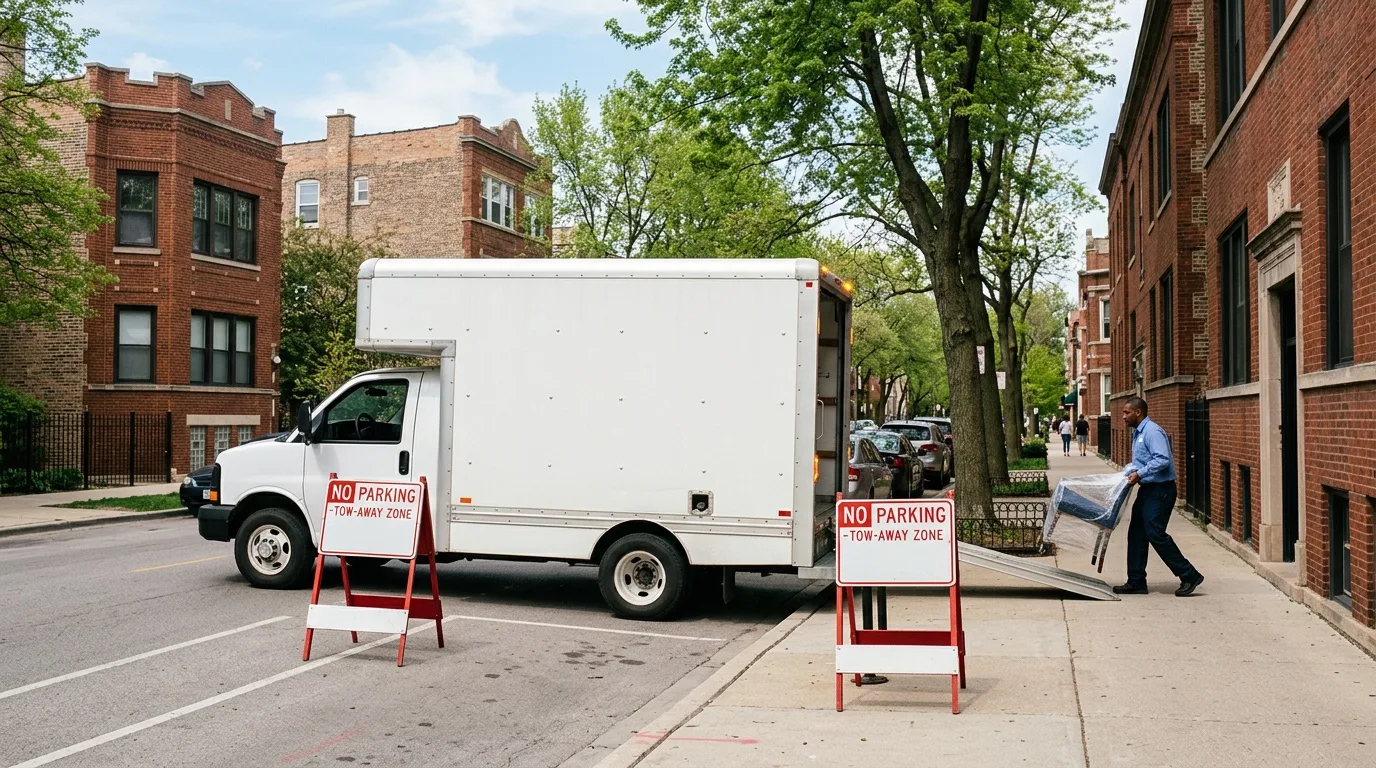
In practice this happens all the time. The truck has arrived at the address to pick up your things, but every parking spot near the building is taken. In Chicago the question of where the moving truck will stand has to be solved before moving day, not when the crew is already at the door.
Why the Curb Matters on Moving Day
If the load is small and light, you can find a spot further away and carry it by hand. But when it is something bulky and heavy, for example a refrigerator or a dresser, carrying it a few hundred feet is very tiring. And a whole apartment is dozens of such trips.
The alternative is to stop the truck in breach of the parking rules. A driver who finds the block full usually has three options left: double park, stop so that the truck blocks other cars, or pull up somewhere they should not. Double parking is prohibited. Stopping so that a parked car has no way out is also a violation. Both can bring a ticket, and in a tow zone the truck can be towed.
Around many high-rises, especially downtown, parking rules are strict. Leaving a truck for several hours at a metered space can turn into a large fine, and in a no-stopping zone into a tow. So the organization of the move starts with a check of the unloading zone at the building: where the legal spots are and whether a special stop has to be arranged with the city.
- Fire hydrants. The space in front of a hydrant stays clear, even for a short load.
- Driveways and alleys. Blocking a neighbor's only way out is a violation, even if you are "just five minutes."
- Loading zones. Commercial loading zones belong to the businesses on the block, not to a residential move.
Narrow streets and gated courtyards are a separate task. The layout of high-rises and older blocks often makes it impossible for a large truck to get in. In that case the truck unloads at an agreed spot, and the things are taken to the door on dollies. This is where the loading and unloading crew spends most of its time.
Keep in mind that a stop in breach of the rules creates problems for everyone else on the street.
Courtesy Signs vs. Enforceable Tow-Zone Signs
In Chicago there are two ways to put up "No Parking" signs for a move, and they work differently. The first is free courtesy signs. You get them from your alderman, through the ward office. They are posted on the block ahead of time, with the date and the hours of the move written on them, and only on spots where parking is legal anyway.
The important thing is that courtesy signs are not enforceable. They ask neighbors to leave the curb free. If someone parks there anyway, the city will not ticket or tow that car because of your sign. Many neighbors respect them, some do not.
The second way is enforceable tow-zone signs. For these you need a permit, which is ordered online through the Chicago Department of Transportation permit portal. The city charges a small fee for it. A car that stays in a permitted tow zone during the posted hours can be ticketed and towed. Usually it is the moving company that requests this permit, since it knows the truck size and the hours.
| Question | Courtesy signs | Tow-zone permit signs |
|---|---|---|
| Where to get them | Alderman / ward office | CDOT online permit |
| Cost | Free | Small city fee |
| Enforceable | No | Yes, ticket and tow |
| Who usually handles it | The resident | Usually the mover |
Which one to choose
On a quiet residential block, courtesy signs are often enough. On a busy street, near a high-rise or on a block where parking is always full, it is safer to have enforceable signs. In a tall building there are usually more neighbors and more cars, and our high-rise tips for Chicago renters cover the rest of that day.
For a family house the situation is often simpler. There may be a driveway or a quieter street. Still, the curb in front of the house has to be checked, as described in our guide to moving into a Chicago house.
Timing: When to Post the Signs
Courtesy signs are posted 48 to 72 hours before the move. Less is risky: neighbors who parked the evening before will not see them. Write the date and the time window clearly, so that nobody can say they did not understand which day was meant.
Access arrangements are not only the signs. They include building access for the crew, the rules for vehicle entry, access to parking, service entrances and unloading areas. If these questions are not solved, the crew can arrive on time and still not be able to start work. It is especially important to agree in advance on the order of carrying things in at buildings with security or a doorman.
The person in charge of the move should find out from the landlord or the building management what the building needs from the mover and where the truck can stand. A high-rise usually asks the mover for a certificate of insurance. It also has to be decided who will meet the crew at the new address and show them the route.
- Signs. Are they still up, and do the date and hours match the move?
- Building. Have crew access, parking and working hours been agreed with management?
- People. Who meets the crew on both ends and shows the route from the truck to the door?
It is convenient to go over this list a day before the move, when it is still possible to fix problems without breaking the schedule. If every point is settled in advance, the crew does not wait for decisions on site but starts working at once. More of these small items are in our moving day checklist for Chicago renters.
The same logic applies on both ends. The curb at the old address and at the new one are two separate problems, and each of them needs its own signs or permit. For an apartment move in Chicago it is worth checking both streets in advance, not only the one you know.
Containers and Moving Pods on the Street
A portable storage container is not a truck that leaves in a few hours. It stands on the street for days. If a container is placed on the public street, a public right-of-way permit is needed. And some wards forbid containers on the street altogether, so check with your ward before you order one.
If there is a driveway or a private lot, the container can often go there instead, and then the street permit is not the question. But loading a container is its own job, and why it pays to have help with it is explained in our article on loading a pods container.
Tell us both addresses and the date, and get a free quote for your move.
Get a Free Moving QuoteBottom Line
A Chicago moving truck parking permit is not needed for every move, but the curb has to be planned for every move. Courtesy signs from the ward office are free and polite, but nobody is obliged to follow them. Enforceable tow-zone signs are a CDOT permit with a small fee, and usually the mover requests them.
Hydrants, driveways and loading zones stay off-limits in any case. For a house move within Chicago or an apartment move, the rule is the same: decide where the truck will stand before the day, not on it.